- Sanzida Afrin
- AI agents for business, AI automation, business process automation, traditional automation, workflow automation
- 0 Comments
- 115 Views
AI agents vs traditional automation is becoming an important question for businesses looking to improve efficiency, automate workflows, and introduce artificial intelligence into everyday operations.
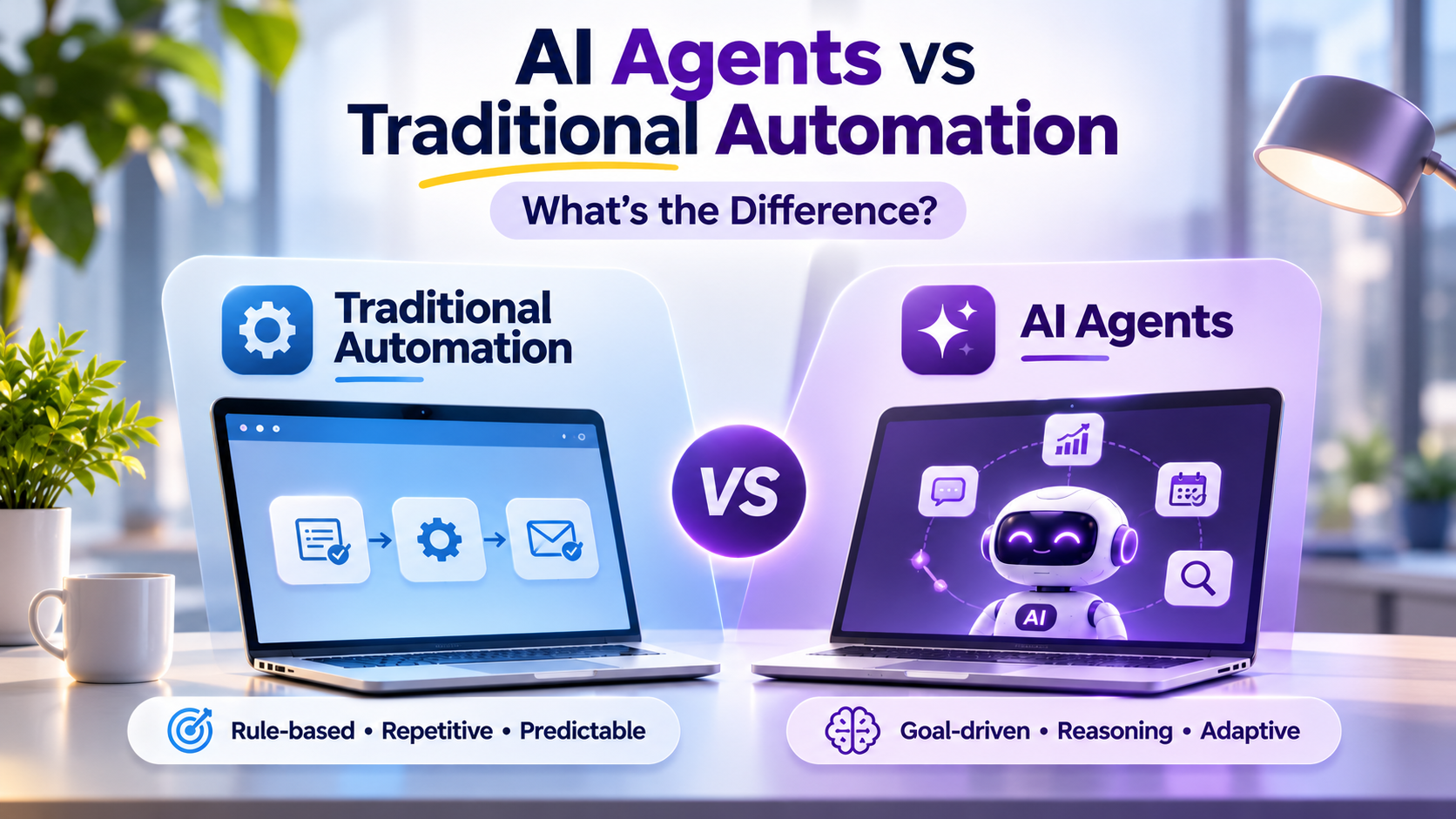
The short answer is straightforward: traditional automation is generally best for predictable processes with clearly defined rules, while AI agents are better suited to workflows that require interpretation, reasoning, tool use, and decisions based on changing circumstances. In many real-world businesses, however, the best solution is not one or the other. A combination of traditional automation and AI agents can often create a more practical system.
Traditional automation has been helping businesses handle repetitive work for years. A system can receive an order, update a database, send a notification, route an approval, or synchronize information between applications according to predefined rules. When the process is stable, this approach remains highly effective.
AI agents work differently. Instead of simply following a predetermined sequence, an agent can interpret a goal, gather information, reason about what to do next, use connected tools, and adjust its actions based on what it discovers. Google Cloud describes agentic workflows as dynamic processes in which AI agents can plan, reason, invoke external tools, and adapt their actions during execution.
That difference matters because not every business problem requires more intelligence. Sometimes the best technology is still a simple, predictable workflow.
What Traditional Automation Does Well
Traditional automation is most effective when a business process can be described clearly in advance.
Imagine an employee submitting a purchase request. If the request is below a certain amount, it goes to one manager. If it exceeds that amount, it goes to another. Once approved, the system records the decision and sends the request to procurement.
There is little ambiguity in this process. The rules are known, the sequence is relatively stable, and the desired outcome is clear.
Using an AI agent in this situation may add complexity without providing much additional value. A conventional workflow can perform the task consistently, predictably, and with relatively straightforward monitoring.
The same principle applies to many common business activities: scheduled reports, database synchronization, fixed approval processes, recurring notifications, standard lead routing, and other workflows where the same conditions usually produce the same outcomes.
Traditional automation also has an important advantage when governance and predictability matter. Because the workflow follows defined rules, businesses can generally understand what will happen before the process runs.
That makes it particularly useful for processes that need clear audit trails and consistent execution.
How AI Agents Change the Automation Model
AI agents introduce a different way of approaching automation.
Instead of giving software a fixed sequence such as “if this happens, do that,” businesses can give an agent a goal and a set of tools, data sources, permissions, and boundaries.
The agent can then determine how to accomplish the objective.
For example, consider a customer who sends a message saying that an order has not arrived.
A traditional automation could identify a keyword and route the message to customer service. An AI agent could potentially understand the customer’s request, identify the relevant order, check shipping information through an API, determine whether the shipment is delayed, prepare an appropriate response, and escalate the issue if it falls outside its authority.
The difference is not simply that one system uses AI.
The difference is how the workflow responds to uncertainty and changing conditions.
Google Cloud defines AI agents as software systems that pursue goals and complete tasks using capabilities such as reasoning, planning, memory, and decision-making.
This makes agents particularly relevant to workflows where the next action depends on information discovered during the process.
AI Agents vs Traditional Automation: A Practical Comparison
The distinction becomes much clearer when the two approaches are viewed side by side.
| Traditional Automation | AI Agents |
|---|---|
| Follows predefined rules | Works toward a defined goal |
| Best for predictable workflows | Better suited to dynamic workflows |
| Usually follows a fixed sequence | Can determine the next step based on context |
| Works particularly well with structured data | Can interpret structured and unstructured information |
| Changes generally require workflow updates | Can adapt within defined boundaries |
| Predictability is a major advantage | Flexibility and reasoning are major advantages |
| Usually easier to test and audit | Requires additional evaluation and governance |
| Best when the process is already well defined | Useful when the process involves decisions and exceptions |
This comparison does not mean that AI agents are the “next version” of traditional automation in every situation.
It shows that the technologies are designed to solve different problems.
A business that uses AI where a simple rule would be sufficient may create unnecessary cost and complexity. A business that tries to force a highly variable process into rigid automation may create an equally frustrating system.
The better question is therefore not “Which technology is newer?”
It is “What kind of problem are we trying to solve?”
When Traditional Automation Is the Better Choice
Traditional automation is usually the better starting point when the workflow is repetitive, stable, and governed by explicit rules.
Consider an invoice approval process. The system may check whether an invoice contains required information, determine who should approve it based on predefined criteria, record the approval, and notify the finance team.
There is no real need for the system to invent a strategy.
The process already has a strategy.
The same applies to data synchronization. If a completed order in an e-commerce platform needs to update a CRM record, an integration can perform that action every time according to defined rules.
This is one reason traditional automation remains valuable even as AI adoption accelerates. Businesses do not need AI simply because AI is available.
Microsoft’s guidance on AI adoption similarly distinguishes between predictable tasks that can be handled through conventional software and more dynamic work where agents can interpret information and determine actions.
For a predictable workflow, reliability can be more valuable than flexibility.
When AI Agents Make More Sense
AI agents become more useful when a workflow involves ambiguity, unstructured information, multiple possible paths, or decisions that depend on context.
Customer service is one example. A customer may describe a problem in their own words, provide incomplete information, or ask several questions in one message. The system may need to interpret the request before deciding what should happen next.
Research is another example. A traditional workflow could collect information from predefined sources, but an AI agent can potentially determine which information is relevant, compare findings, summarize the results, and decide what additional information is needed.
The same principle can apply to internal operations, IT investigation, document analysis, sales research, customer onboarding, and other processes where employees currently spend time interpreting information before taking action.
Microsoft’s enterprise guidance describes agents as capable of orchestrating multi-step processes across systems, making routine decisions within defined boundaries, and escalating exceptions to human reviewers.
This is where AI agents can move automation beyond simply executing tasks toward orchestrating a broader outcome.
AI Agents Do Not Mean Unlimited Autonomy
This is one of the most important considerations for businesses.
An AI agent may be capable of making decisions and taking actions, but that does not mean it should have unrestricted access to business systems.
The more authority an agent receives, the more important governance becomes.
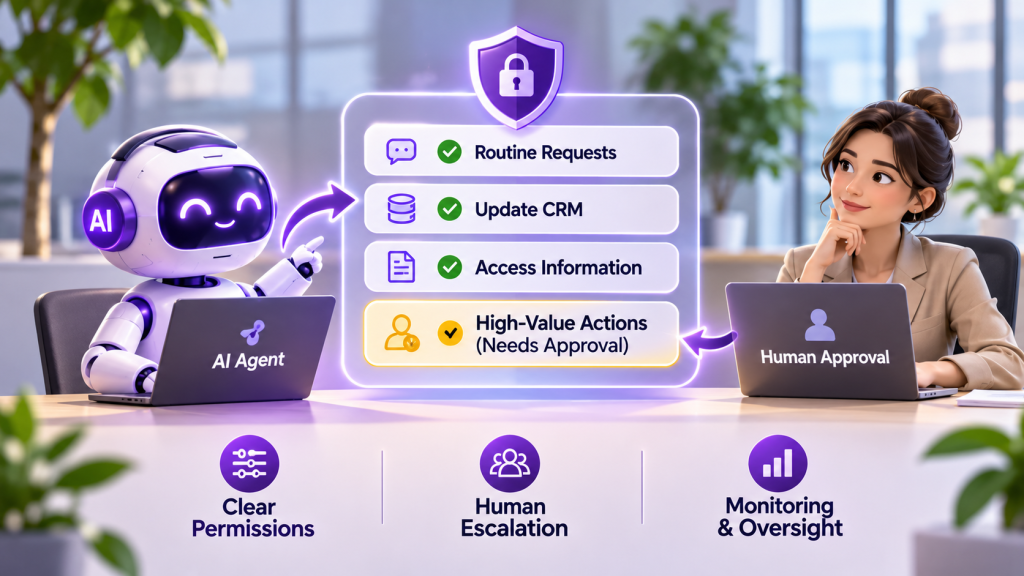
A production agent might have access to customer information, CRM records, internal documents, financial systems, or operational APIs. Businesses therefore need clear boundaries around what the agent can access, what actions it can perform, which decisions require approval, and what happens when the agent is uncertain.
Microsoft’s guidance for core business process transformation emphasizes defined autonomy limits, human escalation, business ownership, monitoring, and explicit decision rights when agents are used in processes with real financial or customer impact.
A practical model might allow an agent to handle routine customer requests automatically while requiring human approval for refunds above a defined amount.
That creates a useful balance:
AI handles predictable decisions within its authority. Humans handle higher-risk exceptions.
This is not a limitation of AI. It is part of responsible system design.
The Real Opportunity: Combining AI Agents With Traditional Automation
Businesses do not necessarily need to choose one technology.
In many cases, the strongest architecture combines both.
Imagine a customer-support workflow. Traditional automation can receive a ticket, identify the customer, update the CRM, and send notifications. An AI agent can interpret the customer’s message, gather relevant information, suggest a resolution, and determine whether the issue appears routine or requires escalation.
Once the agent makes its decision, conventional automation can execute the predictable system updates.
The result is a hybrid workflow.
AI provides interpretation and decision-making. Traditional automation provides predictable execution.
IBM describes this broader movement toward agentic workflows as a shift from automating individual actions toward systems that can reason, decide, act, and coordinate across an entire workflow.
This hybrid approach can be especially useful for businesses that already have established CRM, ERP, e-commerce, accounting, or internal applications.
There is no need to replace every existing workflow just to introduce AI.
Where APIs Fit Into AI Agent Workflows
An AI agent cannot do much inside a business if it cannot access the systems and information required to complete its tasks.
This is where APIs and integrations become important.
Suppose an agent needs to check a customer’s order, update a CRM record, create a support ticket, or retrieve information from an ERP. The agent needs controlled access to those systems.
APIs can provide that connection.
Google Cloud identifies tools, data architecture, orchestration, and runtime as important components of enterprise AI agents.
This means AI adoption should not be considered separately from a company’s broader technology architecture.
If business data is fragmented across disconnected applications, an AI agent may have difficulty providing reliable results. In some cases, improving integrations and data access may be a more important first step than deploying an autonomous agent.
This is also why API integration can become a foundation for intelligent automation rather than simply a technical implementation detail.
AI Agents Require a Different Approach to Testing and Governance
Traditional software is generally designed to produce predictable results from defined inputs.
AI agents are more dynamic.
They may interpret different inputs differently, choose different tools, and follow different paths depending on the situation. That flexibility is useful, but it means businesses need to think differently about testing.
Google Cloud notes that production AI agents require different approaches to testing, orchestration, memory, and security compared with conventional deterministic software.
Businesses should therefore evaluate more than whether an agent “works.”
They should consider whether it stays within its permissions, produces reliable outcomes, handles unexpected situations appropriately, records important actions, and escalates cases when necessary.
IBM similarly emphasizes governance, ownership, observability, and evidence as important foundations for scaling trusted AI agents in real business environments.
The more important the workflow, the more important these controls become.
How to Decide Which Approach Your Business Needs
The decision should begin with the workflow, not the technology.
Ask how predictable the process is.
If the same conditions normally lead to the same actions, traditional automation may be sufficient. If employees regularly interpret documents, understand customer messages, investigate problems, or decide between several possible actions, an AI agent may provide more value.
There is also a useful middle ground.
| Business Situation | Recommended Approach |
|---|---|
| Scheduled reports | Traditional automation |
| Fixed approval workflow | Traditional automation |
| Data synchronization | Traditional automation |
| Rule-based lead routing | Traditional automation |
| Customer request interpretation | AI agent |
| Complex research workflow | AI agent |
| Multi-step investigation | AI agent |
| Fixed process with AI decision points | Hybrid approach |
| AI decision followed by system updates | Hybrid approach |
This approach avoids a common mistake: choosing AI simply because it is more advanced.
The most appropriate technology is usually the one that solves the problem with the right balance of reliability, flexibility, cost, control, and business value.
What Businesses Should Prepare Before Introducing AI Agents
Businesses should begin with a specific business problem rather than a general goal such as “we need AI.”
First, identify a workflow where employees spend significant time interpreting information, making repetitive decisions, or moving between multiple systems.
Then examine the data required to complete that workflow. Is the information accessible? Is it accurate? Are the relevant systems connected? Are there clear rules around sensitive information?
Next, define the agent’s authority.
What can it decide independently? What actions require approval? What happens when information is incomplete? Who owns the business outcome?
Microsoft’s AI agent adoption framework organizes enterprise adoption around planning, governance and security, building, and ongoing management.
Starting with a contained workflow is generally more practical than immediately giving an agent control over a critical business process.
A successful pilot should also have measurable outcomes. Cycle time, accuracy, resolution rate, cost per transaction, employee effort, or customer experience can provide better evidence of value than simply counting how many AI features were deployed.
Our Recommendation for Businesses
Businesses should not replace traditional automation simply because AI agents are becoming more capable.
If a process is predictable, repetitive, and governed by clear rules, traditional automation may remain the better solution.
If a process involves unstructured information, changing conditions, interpretation, or multiple possible paths, an AI agent may be worth considering.
And if a workflow contains both predictable execution and complex decision-making, a hybrid architecture may provide the best result.
The most mature automation strategy is therefore not AI everywhere.
It is the right level of intelligence for each workflow.
Before investing in an AI agent, businesses should ask three questions:
Is the problem actually difficult for traditional automation?
Does the agent have reliable access to the information and tools it needs?
Can we define clear boundaries, ownership, and measurable outcomes?
If the answer to all three is yes, the business may have a strong candidate for agentic automation.
Final Thoughts
The discussion around AI agents vs traditional automation is sometimes framed as a competition in which AI agents will eventually replace conventional automation.
That view misses an important point.
Traditional automation remains extremely effective for processes that are predictable, repetitive, and rule-driven. It provides consistency and control without introducing unnecessary complexity.
AI agents bring something different. They can interpret information, reason about goals, use tools, make decisions within defined boundaries, and adapt their actions as circumstances change.
The future is therefore unlikely to belong exclusively to one approach.
Businesses will increasingly use traditional automation where predictability matters, AI agents where judgment and flexibility add value, and hybrid workflows where both are required.
The smartest automation strategy is not the one with the most AI.
It is the one that understands where intelligence is necessary, where rules are enough, and where humans should remain in control.