- Sanzida Afrin
- 0 Comments
- 8 Views
MVP development for startups has become a practical approach for founders who want to transform software ideas into real products without committing large amounts of time and resources too early.
Many startup founders begin with a strong vision. They identify a market problem, imagine a solution, and start planning a complete application with multiple features. However, building a full product before understanding customer needs can create significant challenges.
The biggest risk is not always technical failure.
A product can be developed successfully and still fail if customers do not find enough value in it.
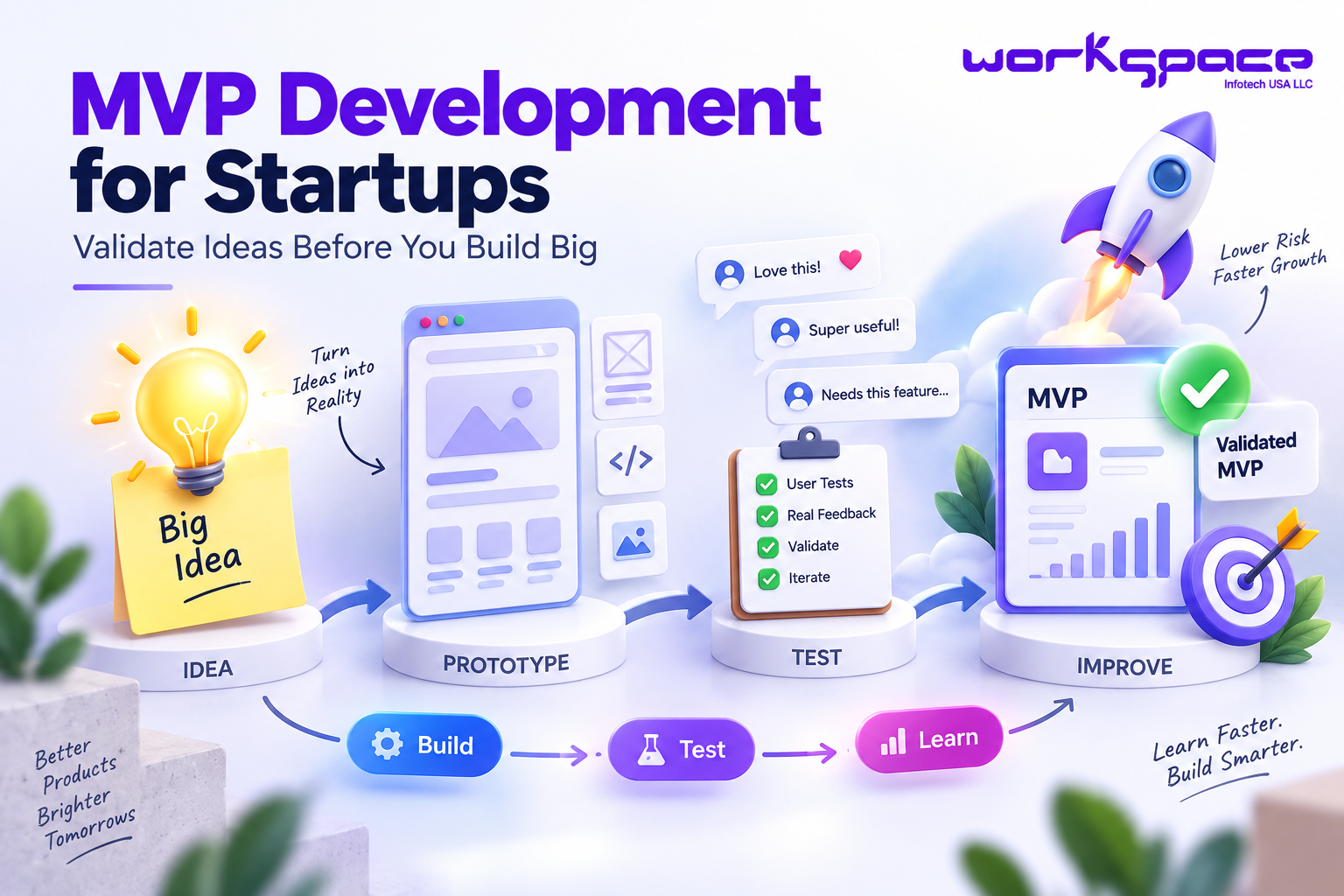
This is why many successful startups begin with a Minimum Viable Product (MVP). Instead of creating a complete platform immediately, founders build a focused version of the product that allows them to test assumptions, collect user feedback, and improve the idea based on real-world experience.
An MVP is not about building less. It is about learning faster.
What Is MVP Development?
A Minimum Viable Product is an early version of a software product that includes the essential functionality required to solve a specific user problem.
The purpose of an MVP is validation.
Before investing heavily in advanced features, businesses can use an MVP to understand whether customers actually need the solution and whether the product direction makes sense.
Eric Ries, author of The Lean Startup, popularized the concept of building, measuring, and learning through early product versions. The idea is that startups should test assumptions through customer interaction rather than relying only on predictions.
For example, a company planning to build an AI-powered customer service platform may eventually want advanced analytics, automation, integrations, and enterprise features.
However, the first MVP may only need the core experience that proves whether businesses are willing to use the solution.
The goal is not to create the final product immediately.
The goal is to create enough value to start learning.
Why Startups Should Validate Before Building a Full Product
Software development requires investment.
Even a simple application requires planning, design, development, testing, infrastructure, and ongoing improvements. When startups build a complete product without validation, they increase the possibility of spending resources on features that customers may not actually need.
One of the most common startup challenges is building based on assumptions.
Founders may believe they understand the market problem, but real users often reveal different priorities after interacting with the product.
An MVP creates a feedback loop between the business and its customers.
Instead of asking:
“Will customers use this product?”
after months of development, founders can answer that question much earlier.
This approach helps startups make better decisions about product direction, feature priorities, pricing models, and future investments.
MVP Development vs Full Product Development
A common misunderstanding is that an MVP is simply a smaller version of a finished product.
That is not completely accurate.
The difference is not only about the number of features. The difference is the purpose behind development.
A full product is designed to serve a broader market with a complete set of capabilities. An MVP is designed to test whether the core idea creates enough value for users.
| MVP Development | Full Product Development |
|---|---|
| Focuses on validating the core idea | Focuses on delivering a complete solution |
| Includes essential functionality | Includes broader features and capabilities |
| Uses customer feedback to guide future development | Usually follows a more established product roadmap |
| Requires less initial investment | Requires greater upfront resources |
| Helps reduce uncertainty before scaling | Designed for long-term market expansion |
The best MVPs are not necessarily the simplest products.
They are the products that provide the clearest answer to an important business question.
Finding the Right Scope for an MVP
One of the hardest decisions for founders is deciding what should be included in the first version.
Many startups make the mistake of trying to include every possible feature because they want the product to appear complete.
However, adding more features does not always create more value.
A strong MVP focuses on the primary problem the product is designed to solve.
For example, a startup building a food delivery platform does not necessarily need advanced recommendation systems, loyalty programs, and complex analytics in the first version.
The initial product may only need:
- customer ordering;
- restaurant management;
- payment processing;
- delivery coordination.
Once users begin interacting with the product, the startup can identify which additional features provide the greatest value.
The question founders should ask is not:
“What features can we build?”
The better question is:
“What is the minimum experience needed to prove that this solution works?”
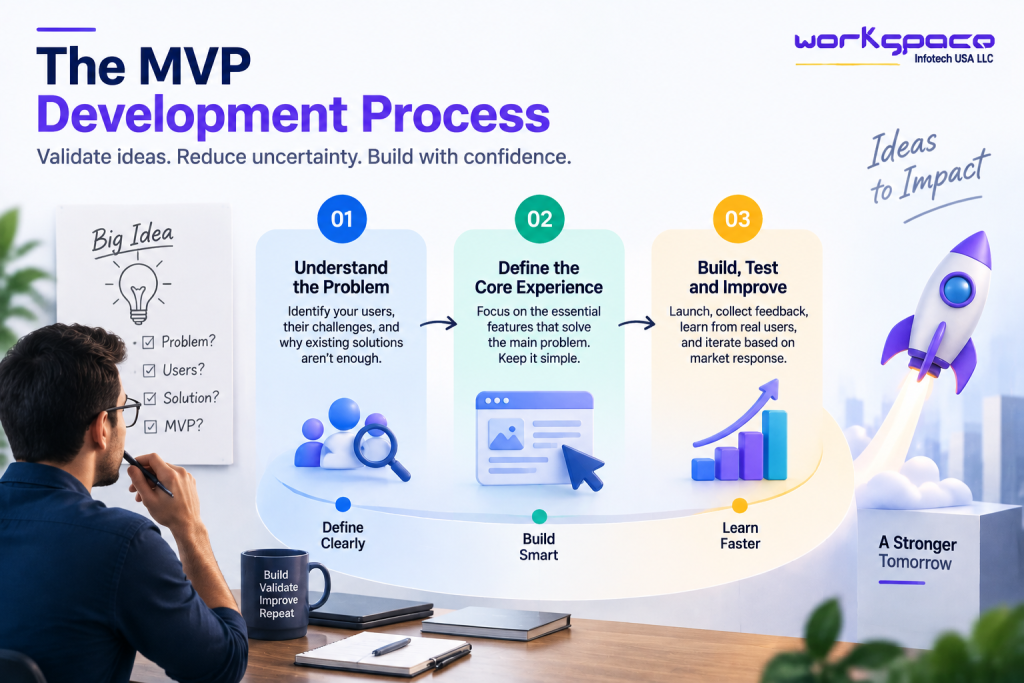
The MVP Development Process
A successful MVP usually follows a structured process. The goal is not only to build software but also to reduce uncertainty.
Understanding the Problem
The first step is identifying the customer problem clearly.
Before development begins, founders should understand who the users are, what challenges they face, and why existing solutions may not be enough.
A clear problem creates a stronger foundation for product decisions.
Defining the Core Experience
After identifying the problem, the next step is determining the essential user journey.
Every feature should support the main purpose of the product.
Features that do not contribute to validating the idea can often be postponed until there is stronger evidence that they are needed.
Building, Testing, and Improving
After launch, the MVP becomes a learning tool.
User behavior, feedback, and market response help founders decide what should happen next.
Some features may become more important. Others may become unnecessary.
This continuous improvement process helps startups avoid investing heavily in the wrong direction.
Common MVP Mistakes Startups Should Avoid
A successful MVP requires discipline.
One of the biggest mistakes startups make is confusing an MVP with a complete product. They spend too much time adding features before confirming whether the core idea has demand.
Another common mistake is focusing only on technology.
A technically impressive application does not guarantee success. The product still needs to solve a meaningful customer problem and provide a simple user experience.
Startups should also avoid ignoring feedback after launch.
An MVP is valuable because it creates learning opportunities. If founders launch the product but do not analyze user responses, they lose one of the biggest advantages of the MVP approach.
How AI Is Changing MVP Development
Artificial Intelligence is creating new opportunities for startups building software products.
Founders can now explore AI-powered capabilities such as intelligent assistants, automated workflows, personalization, and data analysis much earlier in the product development process.
However, AI should be introduced strategically.
Adding AI features simply because they are popular can increase complexity without improving the customer experience.
The strongest AI-powered MVPs are built around clear user needs.
For example, an AI feature that reduces customer support workload or automates a repetitive business process has a clearer value proposition than an AI feature added only for marketing purposes.
Choosing Technology for an MVP
Technology decisions during MVP development can influence the future direction of the product.
Some startups choose technology only based on speed, while others focus only on advanced architecture.
The best approach is usually a balance.
The MVP should be built quickly enough to validate the idea, but the foundation should also allow future improvements without requiring a complete rebuild.
Important considerations include:
- expected user growth;
- security requirements;
- future integrations;
- maintenance needs;
- product roadmap.
A well-planned MVP creates a foundation that can evolve as the business grows.
How Startups Should Evaluate MVP Success
The success of an MVP should not be measured only by the number of features completed.
The more important question is whether the MVP provides useful information about the market.
Founders should evaluate:
- Are users actively engaging with the product?
- Are customers returning after initial use?
- Are users willing to recommend or pay for the solution?
- Which features create the most value?
- What problems do users continue to experience?
These insights help determine whether the startup should expand, adjust, or rethink the product direction.
Our Recommendation for Founders Building Software Products
Startups should treat MVP development as a learning strategy, not just a development shortcut.
The purpose of an MVP is to reduce uncertainty before making larger investments.
Before building a complete product, founders should clearly define the problem, identify the essential user experience, launch a focused solution, and use feedback to guide future decisions.
The strongest products are rarely created by guessing what customers want.
They are created by continuously learning from customers and improving the solution.
Final Thoughts
MVP development for startups provides founders with a smarter path from idea to product.
Instead of spending significant resources building a complete application based only on assumptions, startups can test their ideas, understand customer needs, and make informed decisions.
A successful MVP is not defined by how many features it contains.
It is defined by how effectively it helps a startup discover whether its solution has real value.
For founders building software products in 2026, the goal should not be to build everything at once.
The goal should be to build, learn, and improve until the right product emerges.