- Safayet
- 0 Comments
- 15630 Views
Every growing business reaches a point where spreadsheets, manual work, and disconnected tools are no longer enough. You may need a digital solution, but then comes the big question: should you build a web app, a mobile app, or full custom software first?
This is where many businesses get confused. A founder may think, “We need a mobile app because everyone uses phones.” A manager may say, “We need custom software to automate operations.” A marketing team may want a customer portal or SaaS dashboard. All of them can be right, but not always at the same stage.
The best decision depends on your users, business goals, budget, timeline, and the main problem you want to solve first. You do not always need to build the biggest solution at the beginning. Sometimes, the smartest move is to start small, validate the idea, and scale step by step.
Let’s break down the differences between a web app, mobile app, and custom software so you can decide what to build first.
What Is a Web App?
A web app is a software application that users can access through a browser. It does not require users to download anything from the App Store or Google Play. They can simply open a link from a desktop, tablet, or mobile browser.
Common examples of web apps include CRM dashboards, admin panels, SaaS platforms, booking systems, customer portals, project management tools, and reporting dashboards.
A web app is often a great first choice when your users work from laptops or desktops, or when your business needs a fast and flexible digital platform. For example, if you are building a SaaS product, internal management system, or customer dashboard, a web app can help you launch faster with less complexity.
What Is a Mobile App?
A mobile app is installed directly on a smartphone or tablet. It is usually downloaded from the App Store or Google Play. Mobile apps are built for users who need quick access, smooth mobile experience, and features that use the device itself.
Examples include food delivery apps, ride-sharing apps, fitness apps, banking apps, social media apps, event apps, and eCommerce apps.
A mobile app is useful when your users are highly mobile, need frequent interaction, or depend on phone features like GPS, camera, push notifications, biometric login, or offline access. If your product is something people will use many times a week or even daily, a mobile app can create better engagement.
What Is Custom Software?
Custom software is a broader solution built specifically for your business needs. It can be a web platform, desktop system, mobile app, internal tool, or a combination of many systems.
Examples include ERP systems, inventory management software, HR management software, hospital management systems, logistics platforms, custom CRM systems, and workflow automation tools.
Custom software is the right choice when your business has unique processes that ready-made tools cannot properly handle. It is especially useful when your team is doing too much manual work, using multiple disconnected systems, or struggling to get accurate reports.
For companies with complex operations, custom software development services can help build a system that fits the business instead of forcing the business to fit the software.
Web App vs Mobile App vs Custom Software: Key Differences
Factor | Web App | Mobile App | Custom Software |
Access | Browser | App Store / Google Play | Web, mobile, desktop, or internal system |
Best For | SaaS, portals, dashboards | Mobile-first users | Business-specific workflows |
Initial Cost | Usually moderate | Medium to high | Depends on scope |
Development Time | Faster to launch | Longer if Android + iOS | Varies by complexity |
User Experience | Good across devices | Best for mobile use | Fully tailored |
Maintenance | Easier to update | Requires app updates | Needs ongoing support |
Ideal First Use | MVP or dashboard | Consumer engagement | Internal automation |
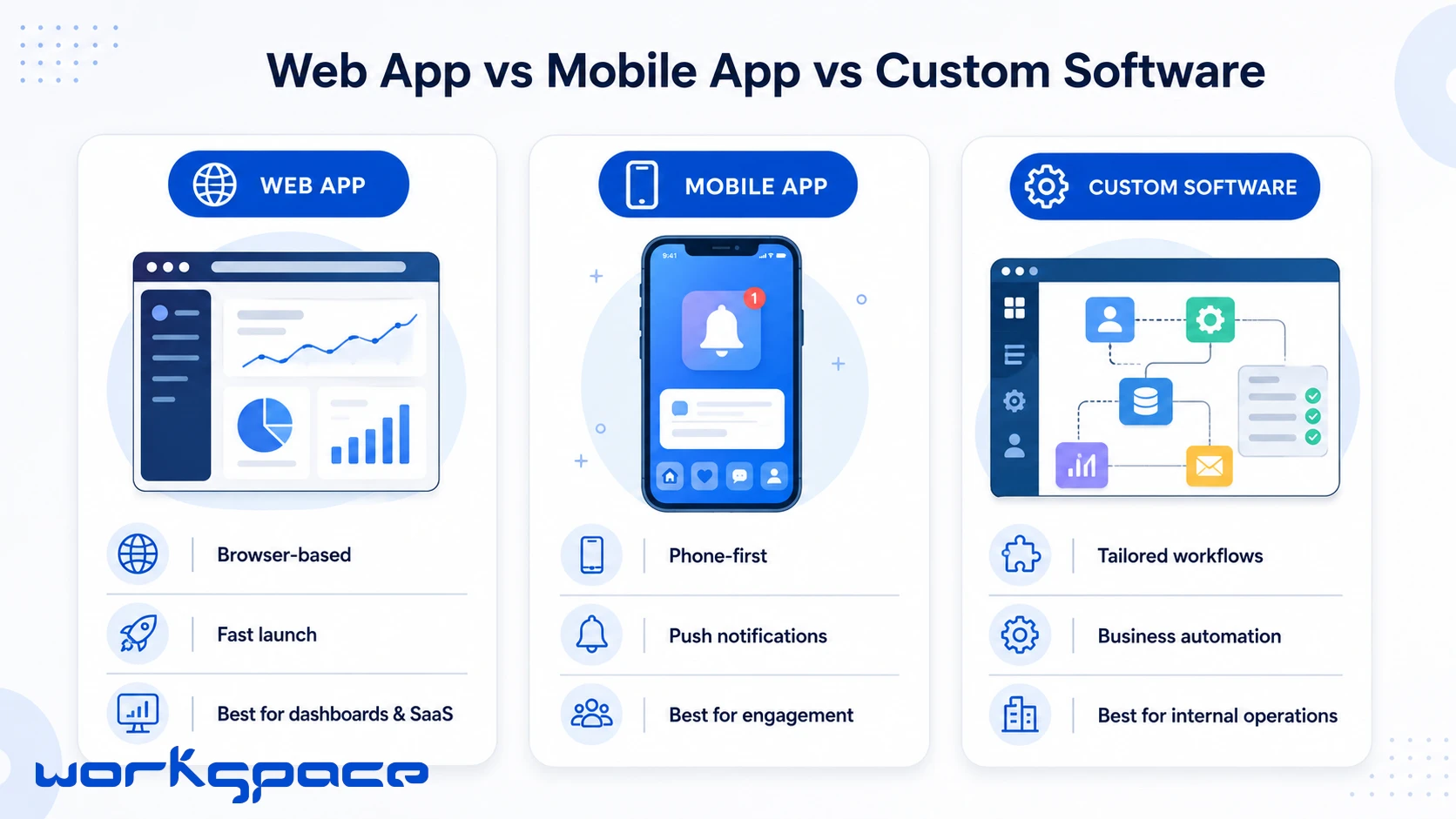
The main difference is not only technical. It is strategic. A web app is usually better for fast validation. A mobile app is better for strong user engagement. Custom software is better for solving operational problems.
When Should You Build a Web App First?
You should build a web app first if you want to launch quickly, test your idea, and serve users across different devices without forcing them to install an app.
For many startups and growing businesses, a web app is the best MVP option. You can build the core features, collect feedback, improve the product, and then decide whether a mobile app is necessary later.
A web app is also useful for B2B businesses where users mostly work from laptops or desktops. Admin dashboards, reporting tools, CRM platforms, vendor portals, and SaaS products often work better as web apps in the early stage.
Another benefit is maintenance. When you update a web app, users instantly see the latest version. You do not need to wait for app store approval or ask users to download updates. That makes web apps easier to manage during fast product changes.
When Should You Build a Mobile App First?
You should build a mobile app first if your users are mostly smartphone users and need fast access throughout the day.
For example, a food delivery business, ride-sharing platform, fitness tracker, social app, or location-based service may need a mobile app from the beginning. In these cases, mobile experience is not just a bonus. It is the main product experience.
Mobile apps are also powerful for user engagement. Push notifications can bring users back. GPS can support location-based features. Camera access can support scanning, uploading, or verification. Offline mode can help users continue using the app even with weak internet.
However, building a mobile app too early can be risky. If your business idea is not validated yet, you may spend a lot of money building features users do not need. That is why many companies first test the concept with a web app or simple MVP before investing in full mobile development.
When Should You Build Custom Software First?
You should build custom software first when your biggest problem is inside your business operations.
For example, your team may be managing orders in spreadsheets, tracking inventory manually, handling invoices through different tools, and preparing reports by copy-pasting data. In that situation, a mobile app may look attractive, but it may not solve the real problem.
Custom software helps connect departments, automate repeated tasks, reduce errors, and improve visibility. It can also integrate with existing tools through API integration services so your business data flows smoothly between systems.
A custom ERP, CRM, HR system, logistics platform, or internal dashboard can save time and improve decision-making. The goal is not just to “build software.” The goal is to remove friction from your daily workflow.
Before starting, it is also smart to prepare a clear software requirements specification. This helps define features, user roles, business rules, and expected outcomes before development begins.
Cost Comparison: Which One Is More Affordable?
In general, a web app is usually more affordable to build first than a full mobile app or complex custom software system. A mobile app can cost more if you need separate Android and iOS versions, although cross-platform technologies can reduce that cost.
Custom software cost depends on the size of the system. A simple internal tool may be affordable, while a full ERP with multiple modules, dashboards, user roles, reports, and integrations will require a bigger budget.
The main cost factors include UI/UX design, number of features, user roles, database complexity, third-party integrations, security, testing, and maintenance.
To plan better, businesses should understand the full software development cost before starting. The cheapest option is not always the best. The right option is the one that solves the right problem at the right stage.
What Should You Build First? A Simple Decision Framework
Start with a web app if you need an MVP, dashboard, SaaS platform, customer portal, or internal system that users can access from browsers. This is usually the safest first step for testing ideas quickly.
Start with a mobile app if your users are mobile-first, need push notifications, depend on GPS or camera, or use the product frequently throughout the day.
Start with custom software if your main challenge is business workflow, automation, data management, reporting, or system integration.
Here is a simple way to think about it:
Business Situation | Best First Choice |
You want to test a SaaS idea | Web app MVP |
Customers need daily mobile access | Mobile app |
Your team struggles with manual work | Custom software |
You need an admin panel | Web app |
You need GPS, camera, or push notifications | Mobile app |
You need to connect departments | Custom software |
MVP Approach: Build Small, Then Scale
A common mistake is trying to build everything at once. That can increase cost, delay launch, and create unnecessary complexity.
A better approach is to build a simple MVP first. An MVP includes only the core features needed to solve the main problem. After launch, you can collect real feedback and improve the product.
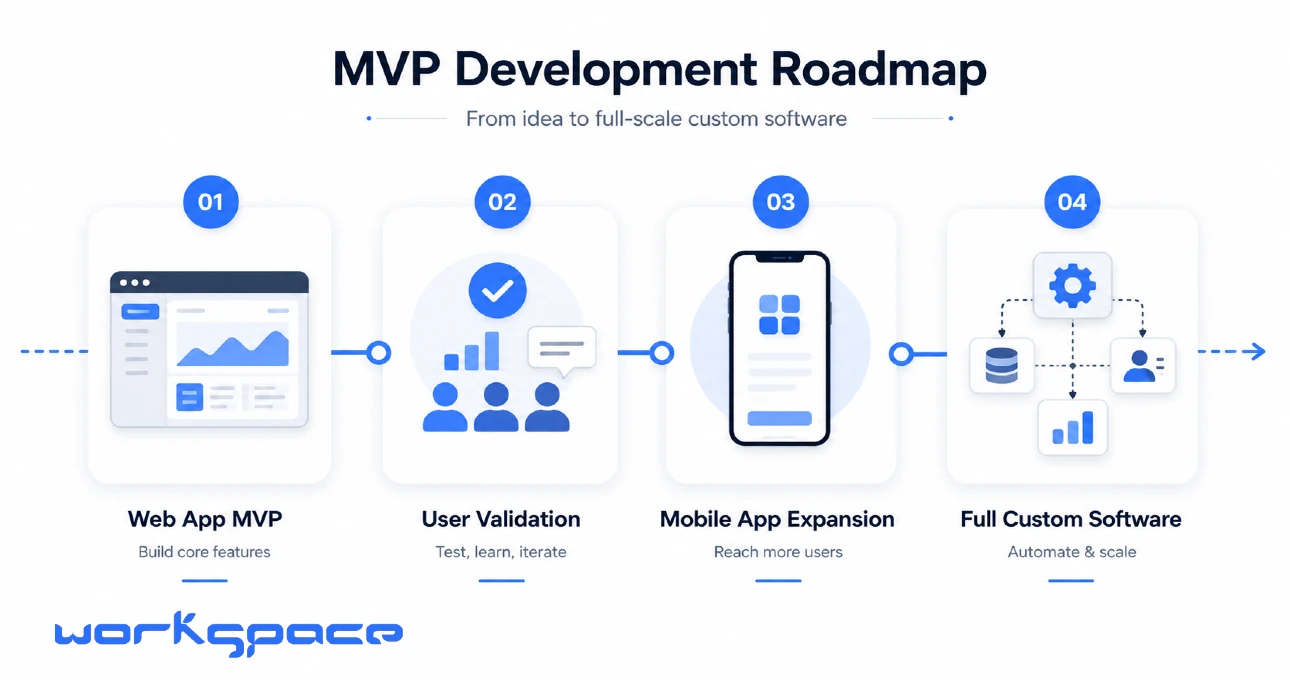
For many businesses, the best order is:
- Build a web app or MVP first
- Validate users and workflow
- Add a mobile app if users need it
- Expand into full custom software as operations grow
This approach reduces risk. You avoid building a rocket when your business only needs a bicycle to start. Later, when the road gets bigger, you can upgrade the vehicle.
Common Mistakes Businesses Make
One common mistake is building a mobile app too early. A mobile app may look modern, but if users do not need it daily, it may not create enough value.
Another mistake is choosing cheap ready-made tools without thinking long term. SaaS tools can be useful, but they may become limiting when your workflow becomes more complex.
Skipping requirement analysis is also risky. Without clear requirements, projects often face delays, confusion, and rework. Businesses should define user roles, features, workflows, and success goals before development begins.
Finally, many companies forget maintenance. Every software product needs updates, bug fixes, security checks, and performance improvements. Launching the product is only the beginning.
Final Recommendation
So, web app vs mobile app vs custom software: what should you build first?
Build a web app first if you want speed, flexibility, and a lower-risk MVP. Build a mobile app first if your users are strongly mobile-first and need frequent engagement. Build custom software first if your internal workflow is the biggest problem and your business needs automation.
The best solution is not always the most advanced one. It is the one that solves your most urgent business problem first.
If you are still unsure, start by mapping your users, business goals, and required features. Then choose the platform that gives you the fastest path to real value. For expert help, you can explore professional software development services and plan the right solution step by step.