
- Sanzida Afrin
- 0 Comments
- 51 Views
Software technical debt is one of the costs that can remain almost invisible while a business is growing. The software may work, customers may be using it, and new features may continue to launch. Yet underneath the surface, shortcuts, outdated architecture, poor documentation, fragile integrations, and accumulated workarounds can make every future change more difficult.
The term “technical debt” comes from a financial analogy. A business can take a shortcut today to move faster, but that decision can create additional work later. The “interest” is paid through slower development, more maintenance, rework, operational problems, and sometimes security or reliability issues.
Technical debt is not automatically a sign of poor development. Some trade-offs are deliberate and reasonable. A startup may intentionally release a simpler implementation to test a product, or a business may accept a temporary workaround to meet an important deadline. The problem begins when those decisions are forgotten, repeated, or allowed to become permanent.
IBM describes technical debt as future costs associated with shortcuts or suboptimal software-development decisions, including quick fixes, poor documentation, outdated code, and architectural compromises.
For business leaders, therefore, the important question is not simply “Do we have technical debt?”
Most growing software systems do.
The more useful question is “How much is our technical debt costing us, and is it beginning to restrict the business?”
What Is Software Technical Debt?
Software technical debt is the additional effort and cost created by technical decisions that make future development, maintenance, or operation more difficult.
The concept was introduced by software developer Ward Cunningham as a way of explaining the trade-off between delivering something quickly and creating a cleaner long-term solution.
The financial comparison is useful because technical debt has both a principal and an interest-like effect.
The principal represents the work required to correct the underlying problem. The ongoing “interest” appears when the debt makes other work slower or more expensive.
For example, a development team might create a quick workaround instead of redesigning a complicated module. The product gets delivered on time. Months later, another feature needs to interact with that module. The developer now has to understand the workaround before making the change, test several related areas, and possibly create another workaround.
The original shortcut has now affected future development.
The problem can continue spreading as more functionality is built on top of it.
Microsoft‘s guidance similarly describes technical debt as accumulated inefficiencies, suboptimal design choices, or shortcuts that can affect software performance and maintainability.
Where Technical Debt Comes From
Technical debt can develop at many levels of a technology environment. It is not limited to badly written code.
Code debt can appear when developers repeatedly use shortcuts, duplicate logic, avoid proper refactoring, or work with inconsistent development practices. Documentation debt can emerge when important technical decisions and system behavior are not recorded.
Architectural debt is often more difficult to see. A system may have tightly connected components that were reasonable when the application was smaller but become difficult to change as the business grows.
There can also be infrastructure and DevOps debt. Outdated deployment processes, inefficient environments, old dependencies, and weak automation can increase the effort required to release and operate software.
Security debt is another concern. Delaying security improvements, continuing to use outdated dependencies, or relying on weak authentication and access-control practices can leave the organization with more work and greater risk later.
IBM identifies several forms of technical debt, including architectural, code, documentation, infrastructure and DevOps, process, and security debt.
This broader view is important because a company can have a technically functional application while still carrying significant technical debt around it.
Why Technical Debt Becomes a Business Problem
Technical debt becomes a business problem when it starts affecting outcomes that management can see.
Development takes longer.
Maintenance consumes more resources.
Releases become harder to predict.
New integrations require more effort.
Performance problems become more difficult to diagnose.
Security improvements take longer.
Eventually, technology decisions begin influencing business decisions.
Imagine a company that wants to launch a new customer portal. The business expects the project to take three months. During development, the team discovers that the existing application has outdated architecture, poorly documented integrations, and several tightly coupled components.
The portal itself may not be particularly difficult to build.
The difficult part is making it work safely with the existing system.
The project takes longer, costs more, and requires additional testing.
That additional effort is one of the ways technical debt becomes a business cost.
Research from the Consortium for Information & Software Quality, presented through NIST, describes technical debt as creating business risk through opportunity costs, liabilities, and continuing IT costs such as maintenance and resource usage.
The Hidden Costs of Technical Debt
The financial impact of technical debt is rarely presented as a single invoice. It is distributed across development, infrastructure, operations, security, and lost opportunities.
| Area | How Technical Debt Creates Cost | Possible Business Impact |
|---|---|---|
| Development | More time spent understanding and changing existing code | Slower feature delivery |
| Maintenance | More debugging, workarounds, and recurring fixes | Higher engineering costs |
| Infrastructure | Outdated or inefficient architecture | Higher operating costs |
| Security | Older dependencies and unresolved technical weaknesses | Greater security and compliance risk |
| Integration | Difficult-to-connect systems and outdated interfaces | Slower digital initiatives |
| Hiring | Developers need more time to understand complex systems | Longer onboarding and higher staffing pressure |
| Innovation | More resources are spent maintaining existing systems | Less capacity for new products and improvements |
The important point is that technical debt does not always show up as a technology expense.
Sometimes its biggest cost is opportunity cost.
A development team spending weeks working around an old system is a team that has less time available to build something that could generate new revenue or improve the customer experience.
IBM’s 2026 research on technical debt similarly highlights reduced development speed, increased complexity, security vulnerabilities, employee churn, and lost agility as consequences of accumulated debt.
Technical Debt Can Slow Business Growth
A growing company needs technology that can change with it.
Customer expectations change. New competitors appear. Businesses add products, enter new markets, introduce new channels, and integrate with other platforms.
A system that was perfectly adequate five years ago may become a constraint when the business operates at a much larger scale.
This is particularly visible when teams start saying things such as:
“We can’t change that because it might break something.”
Or:
“That integration will take several months.”
Or:
“Only one developer knows how that part works.”
These statements can indicate that the organization is paying technical debt interest.
IBM notes that outdated architectures and brittle systems can make new features harder to deliver and reduce an organization’s ability to adapt to emerging technologies.
The business may still be functioning, but its ability to move quickly is declining.
Technical Debt and Legacy Software Are Not the Same Thing
The two concepts are related, but they should not be treated as identical.
Legacy software is generally associated with older systems or technologies that remain important to a business. Technical debt refers more broadly to accumulated compromises and future work created by technical decisions.
A relatively new application can have substantial technical debt if it was built quickly without sufficient attention to architecture, testing, documentation, or maintainability.
Likewise, an older application may be surprisingly stable and well maintained.
The distinction matters because the solution is different.
Replacing software simply because it is old may not solve the actual problem. Similarly, modernizing a system’s user interface does not necessarily address underlying architectural debt.
IBM’s guidance on modernizing older applications makes this distinction clear: technical debt can remain hidden beneath the surface in areas such as poorly structured code, missing automated testing, tightly coupled architecture, and difficult database designs.
How Businesses Can Recognize Growing Technical Debt
Technical debt is difficult to manage if nobody can see it.
The first step is therefore to look for patterns rather than waiting for a major failure.
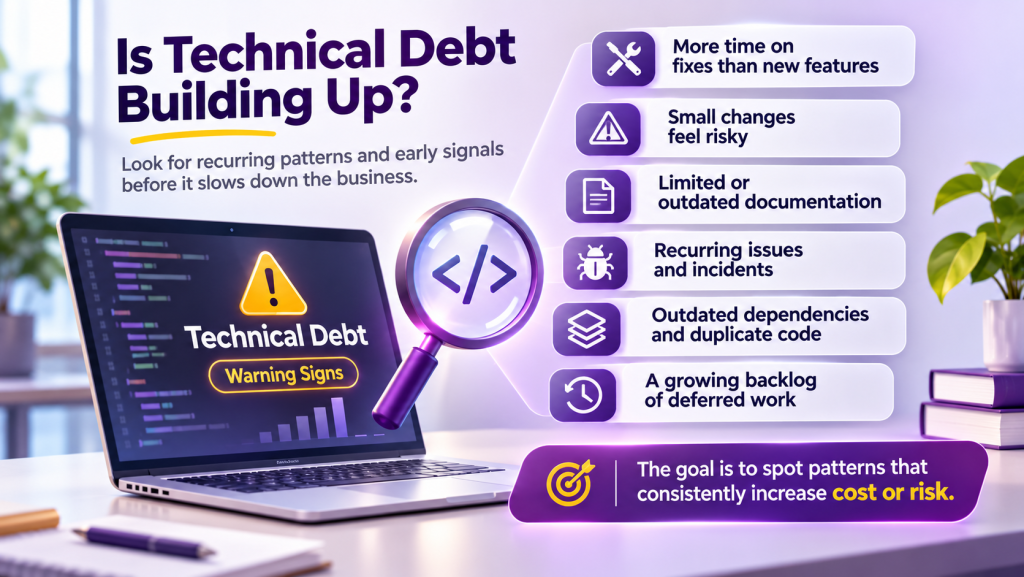
One useful indicator is the amount of time developers spend fixing existing problems compared with building new capabilities. If a growing percentage of development capacity goes toward maintenance, debugging, and workarounds, the underlying system may need closer examination.
Another indicator is change risk. If even small updates require extensive regression testing because teams are uncertain about what might break, the architecture or codebase may have become too tightly coupled.
Documentation also provides clues. If new developers need significant help from a small number of experienced employees to understand how the system works, institutional knowledge may have become a dependency.
Recurring incidents, outdated dependencies, slow deployment processes, duplicated code, and growing backlogs of deferred engineering work can provide additional signals.
The objective is not to label every inconvenience as technical debt.
It is to identify patterns that repeatedly increase the cost or risk of doing normal business work.
Should Businesses Pay Down Technical Debt Immediately?
Not always.
This is one of the most important points about technical debt.
Some debt can be intentional.
A startup may deliberately choose a simpler architecture while validating its product. A company may use a temporary integration to meet a regulatory deadline. A development team may postpone refactoring because delivering an urgent feature has greater immediate business value.
The problem is not taking on debt.
The problem is taking on debt without understanding it.
A useful approach is to evaluate technical debt according to business impact. A small issue that rarely affects development may not deserve immediate attention. A fragile component that blocks a major product initiative may deserve urgent investment.
This is similar to financial debt management.
The goal is not necessarily to eliminate every obligation immediately.
The goal is to understand which obligations are becoming expensive and address them before they restrict future decisions.
How to Reduce Technical Debt Without Stopping Development
Technical debt reduction does not always require a large rewrite.
In many cases, the safer approach is incremental improvement.
A team might refactor one high-risk module while developing a new feature. Another project may replace an outdated dependency during normal maintenance. A company might introduce automated testing around a critical component before making larger changes.
This approach allows technical improvements to happen alongside product development.
Microsoft recommends addressing technical debt as part of continuous performance and engineering improvement, including refactoring code, optimizing database queries, improving architecture, and applying appropriate engineering practices.
The key is prioritization.
Instead of asking:
“How do we eliminate all technical debt?”
ask:
“Which technical debt is currently creating the greatest business impact?”
That question produces a much more practical roadmap.
Technical Debt Should Be Measured in Business Terms
Technical teams naturally look at code quality, complexity, defects, architecture, and infrastructure.
Business leaders need another layer of information.
They need to understand what those technical problems mean for the organization.
For example, instead of reporting:
“The application has high architectural complexity.”
A more useful business statement might be:
“Changes to this module currently require approximately twice the normal testing effort and are delaying releases.”
The second statement connects technology to an operational outcome.
Useful measurements can include development lead time, deployment frequency, recurring defects, incident rates, onboarding time, time spent on maintenance, and the percentage of engineering capacity dedicated to technical debt.
IBM’s recent guidance recommends combining code-level indicators with business-level measures such as bug volumes, product defects, onboarding times, and developer effort spent on firefighting.
That makes technical debt easier for both technology and business teams to prioritize.
AI Is Changing the Technical Debt Conversation
AI-assisted software development creates another reason to pay attention to technical debt.
AI can help developers generate code quickly, explore solutions, and accelerate repetitive development tasks. But faster code generation does not automatically produce better architecture.
If AI-generated code is introduced without adequate review, testing, documentation, and architectural consistency, organizations can accumulate new forms of technical debt more quickly.
IBM’s recent discussion of AI-assisted development highlights issues such as context drift and fragmentation, where generated code can fail to align with existing architecture or unintentionally affect other parts of a system.
This does not mean businesses should avoid AI-assisted development.
It means the faster software can be produced, the more important engineering discipline becomes.
AI can accelerate development.
It does not remove the need to understand what is being built.
A Practical Strategy for Managing Technical Debt
Businesses do not need a complicated program to begin managing technical debt.
Start by identifying the systems that are most important to the business. Then examine where development slows down, where incidents repeatedly occur, and where teams rely on workarounds or specialized knowledge.
From there, classify the problems according to their impact.
High-risk security issues may need immediate attention. Architectural problems blocking major initiatives may deserve planned modernization. Small code-quality issues that have little business impact can often be handled during normal development.
The next step is to create a realistic improvement roadmap.
Rather than separating all technical work into a giant “technical debt project,” organizations can incorporate selected improvements into product development, maintenance cycles, modernization initiatives, and infrastructure work.
This makes debt reduction part of normal engineering rather than an initiative that is repeatedly postponed.
Our Recommendation for Businesses
Businesses should stop treating technical debt as something that belongs only to the development team.
It is ultimately a business concern because it affects how quickly and safely the organization can change.
A technology team may see technical debt as difficult code, outdated dependencies, poor documentation, or architectural limitations. A business leader experiences the same problem as slower releases, higher costs, delayed projects, operational risk, or missed opportunities.
Both views describe the same underlying issue.
The most effective strategy is not to eliminate every technical imperfection. It is to understand the debt, measure its impact, prioritize the most expensive problems, and gradually improve the areas that are restricting the business.
That approach allows companies to maintain delivery speed without allowing short-term decisions to quietly become long-term constraints.
Final Thoughts
Software technical debt is often invisible until it starts affecting something the business cares about: delivery speed, operating costs, security, reliability, customer experience, or the ability to launch something new.
That is why technical debt should not be viewed simply as “bad code.”
It is the accumulated cost of decisions that make future change harder.
Some technical debt is reasonable. Some is unavoidable. But unmanaged technical debt can compound over time, making systems more expensive to maintain and businesses slower to adapt.
The goal is therefore not to build software with zero technical debt.
The goal is to build an organization that knows where its technical debt exists, understands what it costs, and pays down the most important parts before they become business-critical problems.
In a technology environment where software changes faster than ever, that discipline can become a competitive advantage.